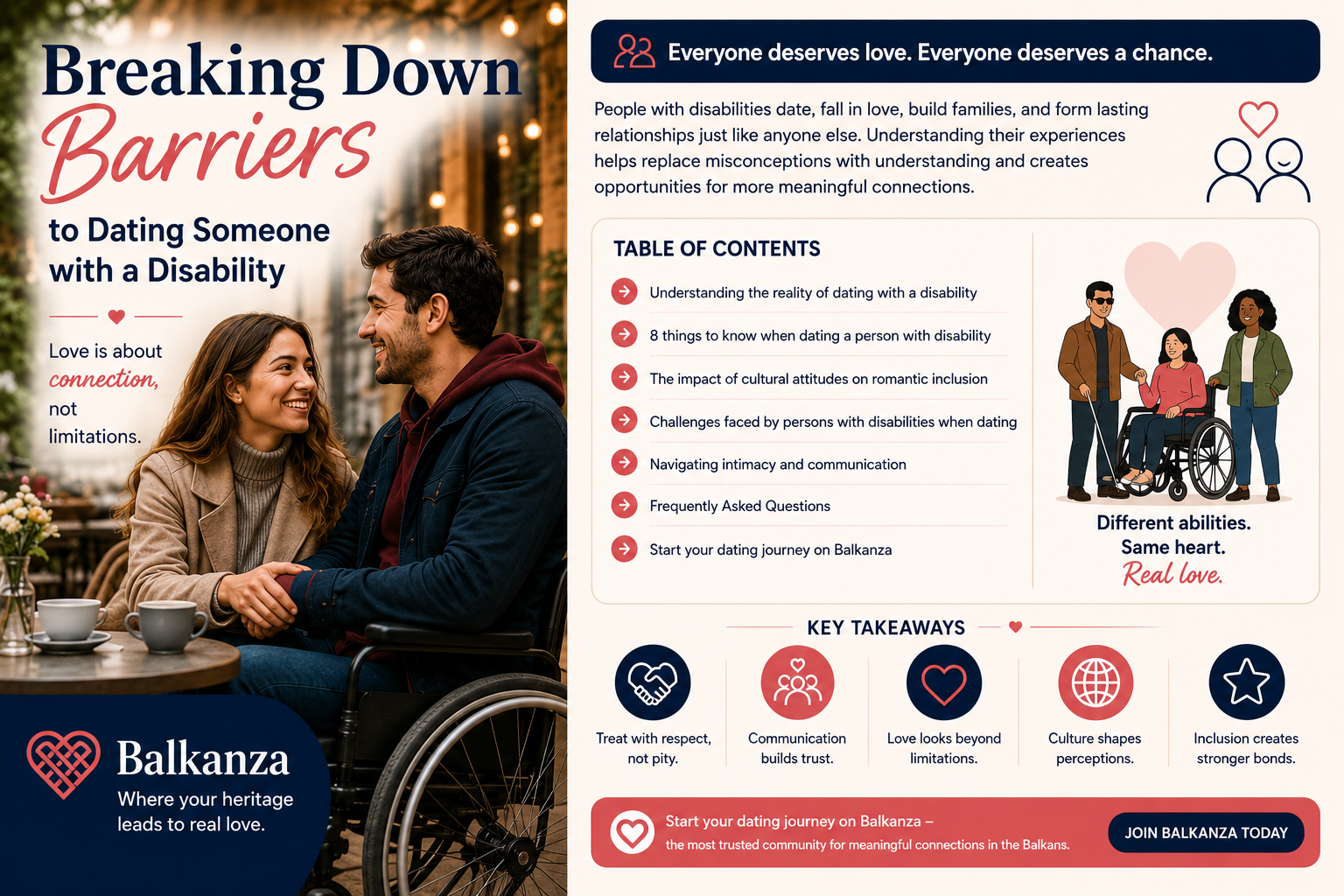
Social life and romantic connections are fundamental parts of the human experience, including for the estimated 100 million adults living with disabilities in the European Union. When looking at the wider WHO European Region, the figure rises to about 135 million people. These numbers highlight that a significant part of the population lives with physical, sensory, or cognitive disabilities.
People with disabilities date, fall in love, build families, and form lasting relationships just like anyone else. Yet outdated stereotypes and accessibility barriers can still shape how others perceive dating and disability. Learning more about these experiences helps replace misconceptions with understanding and creates opportunities for more meaningful connections.
Many people in the Balkan region and around the world still hold misconceptions about what it means to date someone with a disability. This guide explains common myths, offers practical advice, and shares tips to help you build a respectful, supportive, and meaningful relationship with a person who has a disability.
Table of Contents:
Understanding the reality of dating with a disability
Things to know when dating a person with disability
The impact of cultural attitudes on romantic inclusion
Challenges faced by persons with disabilities when dating
Navigating intimacy and communication
Frequently Asked Questions
Start your dating journey on Balkanza
Understanding the reality of dating with a disability
Dating a person with a disability requires a mindset of openness and equality. There is no single way to experience life with a disability because no two conditions are exactly the same. Each individual manages their health and their daily routine differently. Some people may require specific physical accommodations while others deal with invisible symptoms that fluctuate from day to day. Recognizing that every person is an expert on their own body is the first step toward a healthy partnership.
A 2022 study by Isaac Man Hei Ip, Anne Honey, and Margaret McGrath titled "Attitudes Toward Dating People with Disability Amongst Young People in Australia and Hong Kong" provides deep insights into this topic. The researchers found a strange contradiction in how people choose partners. Most participants listed loyalty, honesty, kindness, and a sense of humor as their top priorities. These are universal traits that are entirely unaffected by a disability. However, when those same participants were asked if a disability would change their dating choices, the majority admitted they would feel reluctant to date someone with a disability. This shows that while we value the right character traits, social bias still plays a large role in romantic exclusion.
8 things to know when dating a person with disability
Dating a person with a disability involves moving past stereotypes and treating the individual with the respect they deserve. It is about building a connection based on who they are rather than what their medical chart says. Here are the core things to keep in mind when you are interested in someone who lives with a disability.
Interact naturally. Treat the person with the same respect and interest you would show anyone else. If they share information about their disability, ask respectful questions about their experience instead of offering pity. Phrases like "I am sorry" or "That must be hard" create an immediate power imbalance. Most people welcome genuine interest but they do not want to be treated as a tragedy.
Acknowledge privilege. Recognize that going through the world as an able-bodied person is much easier and less exhausting. Many people with disabilities use the "spoon theory" to describe their daily energy levels. Each task costs a "spoon" and they only have a limited number each day. Interacting and dating takes a high level of mental and physical energy. You should be grateful and flattered that they choose to spend their limited energy on you.
Fight ableism. Take an active interest in disability rights and awareness. Ableism is a daily struggle that people face in grocery stores, workplaces, and doctors' offices. Being a real ally means educating yourself on these issues so your partner does not always have to be the one to speak up. Do not defend ableist comments or behaviors. Showing that you are an ally builds the trust and safety necessary for a deep bond.
Seek no rewards. Realize that dating someone with a disability does not make you a "better" person. You are not a hero or an inspiration for being in a relationship with a person you find attractive and interesting. They are real people with careers, hobbies, and goals. If you feel like you need a prize every time you help them when they are sick, you are not ready for a mature relationship.
Respect their expertise. Trust the person to know what is good for them and what they need. One of the biggest frustrations for people with disabilities is when a partner assumes they know best. Always ask before helping. Doing something you think is considerate without asking can sometimes lead to sadness or frustration because it takes away their agency.
Prioritize communication. Understand that your sex life will be healthy and fulfilling if you keep the lines of communication open. There is often a fear among able-bodied people that intimacy will be impossible or difficult. This is a myth. As long as both partners talk about their needs and desires, intimacy remains great.
Include them. Invite the person to parties, dinners, and trips regardless of their physical limits. Just because they cannot do a specific activity does not mean they do not want to be included in the social circle. Let them decide if they are up for the event. Being invited shows that you value their presence and want them to be part of your world.
Offer support. Be ready to help when they ask for it. Living with a disability does not mean someone has stopped wanting to travel or go to concerts. It just means those things are harder to do alone. Having a partner they trust makes life much more enjoyable and and allows them to experience more of the world alongside you.
Challenges faced by persons with disabilities when dating
Dating a person with a disability comes with specific social and economic hurdles that the couple must face together. These challenges are often the result of how society is built rather than the disability itself. Understanding these obstacles helps partners support each other more effectively.
Social stigma. Many people wrongly believe that individuals with disabilities cannot love or be loved in return. They assume that a disabled person cannot meet emotional or sexual responsibilities. These false beliefs limit dating opportunities and make it harder for people to be seen as viable romantic partners.
Family pressure. Families in some cultures may reject the relationship or push the non-disabled partner to find someone else. This pressure can cause immense emotional pain and break even the strongest bonds. It requires both partners to be firm in their commitment to each other.
Confidence issues. Constant mockery or exclusion can lead to lower self-esteem for some individuals. They may fear rejection or doubt their worth because of how society has treated them for years. A supportive partner helps call out these insecurities and reinforces their value.
Financial barriers. Discrimination in employment means many people with disabilities face financial instability. Society often wrongly equates a person's worth with their bank account. This is a particular challenge for men in traditional cultures who feel the pressure to be the primary provider.
Accessibility hurdles. Inaccessible housing and transportation can limit a person's independence. It makes planning dates more difficult and can create an unfair sense of dependency. Partnership involves support in different forms, but physical barriers make that support more complicated.
Sexual myths. Harmful myths suggest that people with disabilities are asexual or unable to have children. These lies lead to avoidance and disrespect in the dating world. In reality, people with disabilities have the same sexual desires and capabilities as anyone else.
Exploitation risks. People with disabilities are sometimes more vulnerable to emotional manipulation or abuse. Some partners may see them as easy targets. This fear can make it difficult for someone to open up to a new relationship.
Legal gaps. In many parts of the world, marriage rights are not fully protected for those with disabilities. Support systems for couples are often weak, and there is very little counseling available that is tailored to disability inclusion.
Cultural interpretations. Some cultures wrongly link disability to bad luck or punishment. This affects marriage acceptance, especially for women. These outdated beliefs create a toxic environment for those seeking love.
Invisible role models. There is a lack of positive stories about happy marriages and families involving people with disabilities. Without visibility, it is harder for young people to hold onto hope for their own romantic futures.
The impact of cultural attitudes on romantic inclusion
The 2022 Ip, Honey, and McGrath study also highlighted significant cultural disparities in dating attitudes. Young adults surveyed in Hong Kong expressed much more resistance toward dating a person with a disability compared to their peers in Australia. This proves that culture is a major determinant in social inclusion. In some regions, the type of disability also matters. Physical disabilities were often seen as less of a barrier than intellectual or developmental disabilities.
These cultural barriers mean that people with disabilities often have to work harder to find acceptance in their local communities. However, as the world becomes more connected, these attitudes are slowly shifting. Younger generations are beginning to see that a person's character and values are far more important than their physical abilities.
Frequently Asked Questions
How should I talk to my date about their disability?
You should wait for them to lead the conversation. It is okay to ask respectful questions once they bring the topic up first. Most people appreciate it when you are direct and honest because it helps build trust. It is always better to listen and learn about their specific needs rather than guessing on your own.
What if my family does not approve of my partner having a disability?
You must stay firm in your choice and show them why you value your partner. Focus on their character and the happiness they bring into your life. Families sometimes need a little extra time to move past their own ideas and see the reality of your relationship. You should stand by your partner and lead with confidence.
Is it okay to ask questions about how their disability works?
Yes. It is fine to ask as long as you are being respectful and truly interested in their life. You should avoid making assumptions that might be wrong. Wait for a natural moment when you are both talking and let them decide how much they want to share with you.
Can people with disabilities have long and happy marriages?
Yes, and in fact, millions of people with disabilities are in healthy and long-lasting marriages. Success in any marriage comes down to communication and shared values. Mutual support is a trait that any couple can develop over time regardless of physical ability.
How do we handle dates at places that are not accessible?
Planning ahead is the best way to find ideal places for a date when you’re with someone who has a disability. You should check a location before you go or choose spots that you already know are easy to get into. Working together on the details can actually make your bond stronger. You learn how to handle hurdles as a team right from the start.


