Marriage: Meaning and importance
 By the Balkanza team
·
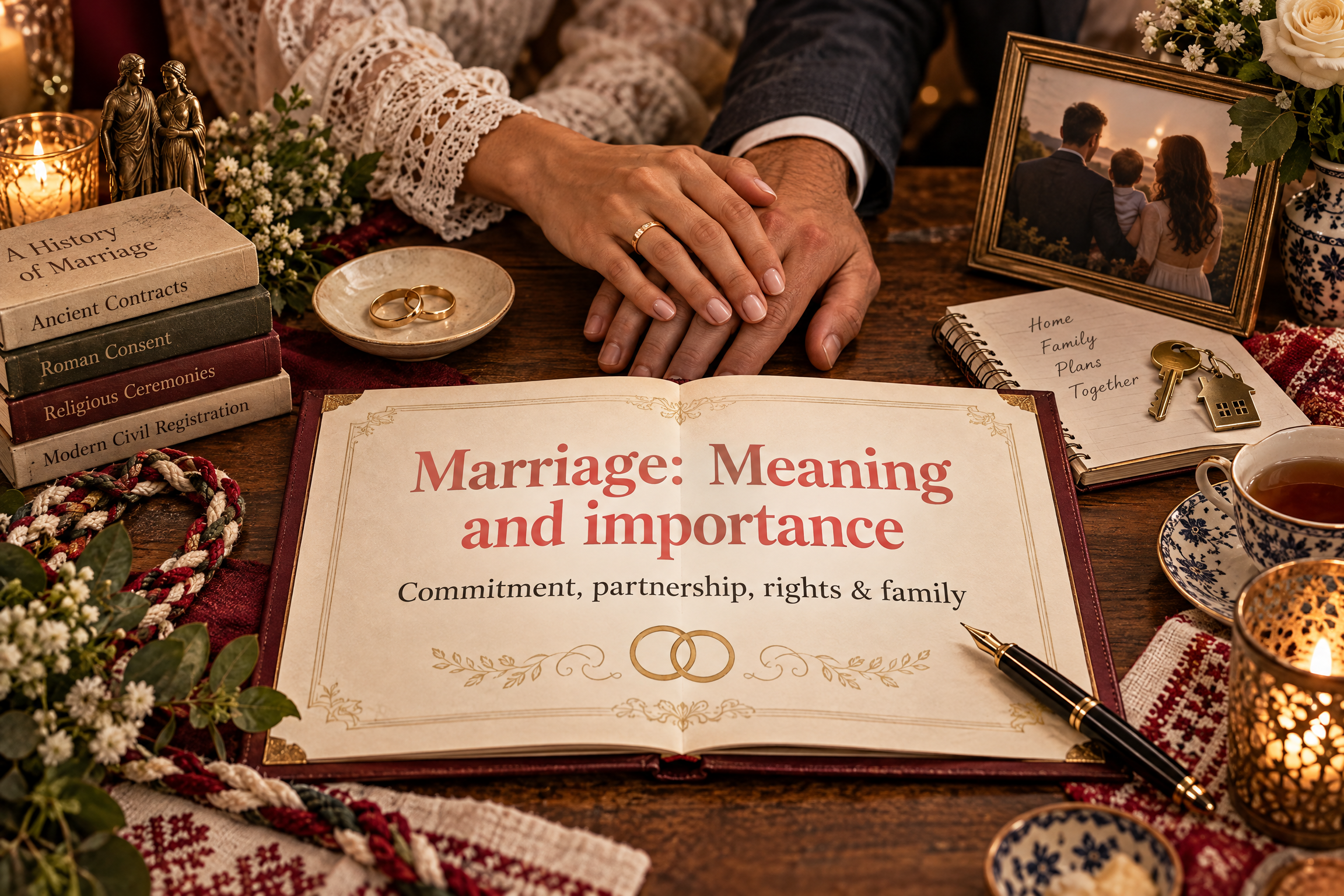
Marriage meaning and importance start with a simple definition of a legally and socially recognized union between spouses. Marriage meaning and importance extend to the rights, responsibilities, and commitments that the union creates for spouses and extended families. The meaning of marriage covers legal, social, cultural, religious, and personal commitments, and each dimension carries different weight across societies. The United States recorded 2,128,446 marriages in 2024, a rate of 6.3 per 1,000 residents, according to provisional CDC data. The figures show that the institution remains central to adult life even as customs and laws evolve.
Marriage is based on commitment, partnership, shared responsibilities, and legal or social recognition. Foundations vary across cultures, religions, and legal systems, so the same union carries different expectations in different communities. Legal frameworks reach back thousands of years, and Mesopotamian contracts, Roman consent rules, and church decrees each shaped modern marriage law. Modern jurisdictions attach property, inheritance, tax, and parental rights to the same recognition. Couples add personal meaning through love, companionship, family goals, and shared values. The sections below explain the definition, foundations, benefits, history, cultural differences, and present-day purpose of marriage.
What is Marriage?
Marriage is a legally and socially recognized relationship between spouses that creates rights and responsibilities. The legal dimension covers property, inheritance, taxes, and parental duties. A 2004 review by the U.S. Government Accountability Office counted 1,138 federal provisions that depend on marital status. The social dimension gives the couple public standing within family and community networks. The cultural dimension shapes ceremonies, names, and household roles. The religious dimension frames the union as a sacred covenant or sacrament in traditions (Christianity, Judaism, Islam). The personal dimension reflects love, loyalty, and the decision to build a shared life. The specific rights, duties, and requirements of marriage vary by jurisdiction and cultural context. Minimum age, consent rules, registration steps, and recognized forms of union differ from country to country. Legal recognition in the United States, for example, extended to same-sex couples nationwide through Obergefell v. Hodges in 2015. The meaning of marriage depends on the legal system and community that recognize the union.
What does Marriage Represent for a Couple?
Marriage represents a formal commitment for a couple to build a shared life and support one another. Couples associate the union with love, partnership, family, stability, and shared goals. A spouse becomes a primary source of emotional support, financial cooperation, and daily companionship. Personal meaning varies according to the couple’s circumstances and values. Partners focused on raising children emphasize family stability, while partners focused on careers emphasize teamwork and mutual encouragement. Religious couples add spiritual vows, and civil couples emphasize legal protection and equal partnership. The shared decision to marry turns private affection into a public promise that family, friends, and the state recognize.
Is Marriage a Legally Recognized Relationship?
Yes, marriage is a legally recognized relationship in jurisdictions that register and recognize the union, and recognition creates specific rights and obligations for spouses. The rights and obligations involve property, inheritance, taxes, parental responsibilities, and decision-making. In the United States, a marriage license and a recorded certificate establish the legal record. Spouses file joint tax returns, and registration gives documentary proof for insurance, hospital visitation, and immigration. The exact legal effects depend on the laws of the jurisdiction, so rules on age, consent, property, and divorce differ between countries and states.
What is Marriage Based on?
Marriage is based on commitment, partnership, shared responsibilities, and legal or social recognition. Commitment appears in vows, promises, and the intent to remain together through changing circumstances. Partnership appears in shared decisions about money, housing, work, and family plans. Shared responsibilities cover household duties, financial support, and the care of children or relatives. Recognition comes from a government registry, a religious authority, or a community that acknowledges the union. Article 16 of the Universal Declaration of Human Rights (1948) adds free and full consent of the intending spouses as a core requirement. The foundations of marriage vary across cultures, religions, and legal systems. Roman law treated mutual consent as the core of marriage, and later canon law carried the principle into European legal systems, shaping the rights, responsibilities, and expectations of spouses in each society. Modern civil systems add age limits, consent rules, and registration steps to the foundation.
What are The Main Elements of Marriage?
The main elements of marriage are legal rights, financial benefits, social recognition, and a family framework. Each element turns a private commitment into a recognized structure with defined obligations. The elements appear in civil and religious systems, though the details change by jurisdiction.
The main elements of marriage are listed below.
Legal Rights: Property, inheritance, and decision-making rights belong to each spouse once the union is registered.
Financial Benefits: Potential tax, insurance, and financial protections apply when a jurisdiction links benefits to marital status.
Social Recognition: Formal recognition of the couple’s relationship gives the union public standing among family and community.
Family Framework: A recognized structure for family responsibilities defines roles for spouses, children, and extended relatives.
Does Communication Help Make a Marriage Work?
Yes, communication does help make a marriage work because effective communication helps spouses understand each other, resolve disagreements, and coordinate responsibilities. Honest and respectful communication strengthens trust and cooperation. John Gottman’s research reports that stable couples show about five positive interactions for each negative interaction during conflict. Regular communication helps couples address problems early and maintain a healthy partnership. Weekly check-ins, clear budget conversations, and shared parenting plans turn expectations into agreements. Listening without interruption and naming feelings directly keep disagreements constructive. Daily communication habits form the practical core of What Makes a Marriage Work.
Can Communication Help Restore a Struggling Marriage?
Yes, communication helps restore a struggling marriage when spouses commit to honest and consistent conversation. Structured conversations about unmet needs, stress, money, and intimacy replace blame with problem-solving. Emotionally Focused Therapy studies report that about 70 to 75% of couples move from distress to recovery after a course of therapy. Professional counselors teach listening skills, repair attempts, and conflict pauses that keep tension from escalating. Progress takes consistent effort over weeks and months, and trust returns gradually through reliable behavior. Open dialogue, counseling support, and clear commitments form the starting point of How to Save a Marriage.
Why is Marriage Important?
Marriage is important because it provides a recognized framework for commitment, partnership, family life, and shared responsibilities. The personal significance includes emotional security, companionship, and a lifelong partner for major decisions. The social significance includes public recognition, extended family ties, and a stable setting for raising children. The cultural significance includes traditions, ceremonies, and values passed across generations. The legal significance includes inheritance protection, spousal decision-making authority, and access to benefits tied to marital status. Marriage reached a peak rate of 16.4 per 1,000 residents in the United States in 1946, so social importance shifts with era and economy. The national divorce rate stood at 2.4 per 1,000 residents in 2023, down from 4.0 in 2000, which points to a long-term decline in divorce. Adults weigh legal protection, faith, and family expectations differently. Personal values and social or legal context decide the answer to Why is Marriage Important?
What are The Main Benefits Of Marriage?
The main benefits of marriage are legal rights, financial benefits, social recognition, and a family framework. Each benefit protects spouses and children during major life events. The availability of each benefit depends on the jurisdiction and its laws.
The main benefits of marriage are listed below.
Legal Rights: Spouses receive inheritance claims, property standing, and spousal decision-making rights during illness or emergencies.
Financial Benefits: Potential tax, insurance, and financial protections include joint filing, spousal coverage, and survivor benefits.
Social Recognition: Formal recognition of the couple’s relationship gives the union public standing among relatives, employers, and institutions.
Family Framework: A recognized structure for family responsibilities clarifies parental duties and household roles.
Can Marriage Provide Social And Legal Benefits?
Yes, marriage provides social recognition and legally established rights. The rights include inheritance, property, insurance, and spousal decision-making authority when a partner is incapacitated. In the United States, surviving spouses qualify for Social Security survivor benefits after a qualifying marriage. Social recognition includes acknowledgment from relatives, employers, and communities, which supports family stability and shared planning. Specific benefits depend on the jurisdiction and its laws, so spouses verify local rules on tax treatment, inheritance, and insurance coverage before making financial decisions.
How has Marriage Changed Over Time?
Marriage has changed over time from arrangements shaped by family, property, kinship, and social alliances toward greater emphasis on individual choice and partnership. In ancient Mesopotamia, marriage began with a written contract negotiated by representatives of two families. Hammurabi’s Code made a suitor forfeit the betrothal gift and bride-price after withdrawing from the engagement. Medieval Europe placed marriage under growing church authority, and civil states later reclaimed legal control through registration and licensing. Legal rights changed significantly over the centuries, and gender roles moved from fixed household duties toward negotiated equality. Economic conditions reshaped the institution as wage work, education, and dual incomes changed household decisions. Cultural expectations shifted as couples gained freedom to choose partners, delay weddings, and define roles by agreement. The United States marriage rate stood above 10 per 1,000 residents in the early 1980s and measured 6.3 in 2024. Marriage practices continue to vary across societies and historical periods.
Where did Marriage Originate?
Marriage originated in no single known place, and formalized unions existed in ancient societies across the Near East and beyond. Evidence of marriage practices appears in ancient Mesopotamia, where the Code of Ur-Nammu (c. 2100 to 2050 BCE) and the Code of Hammurabi (c. 1754 BCE) regulated marriage contracts, divorce, and family obligations. Egyptian, Hebrew, and Roman sources document betrothal customs, dowries, and legal consent in early civilizations. Because marriage developed in different cultural contexts, its origins cannot be attributed to one specific society. Anthropologists describe marriage as a response to shared needs, including property transfer, kinship alliances, and child rearing.
Did Marriage Begin as a Religious Institution?
No, marriage did not begin as a religious institution, since documented ancient unions rested on family contracts, property arrangements, and social alliances. Church weddings probably did not exist in early Christian customs, and couples married outside the church. By around AD 700, French ritual placed the wedding at the church gate, and religious authority expanded across medieval Europe. The Council of Trent decree Tametsi in 1563 required a public ceremony before a priest and two or more witnesses. Religion shaped marriage deeply over time, yet the institution predates formal church control.
How does Marriage Differ Across Cultures?
Marriage differs across cultures in customs, legal rules, family roles, ceremonies, and expectations. Religion, traditions, kinship systems, and local laws influence how marriage is practiced. Hindu weddings center on the saptapadi, seven steps taken around a sacred fire. Islamic marriage rests on a nikah contract with spousal consent and a mahr gift from the groom. Jewish weddings include the ketubah, a written marriage contract that records the husband’s obligations. Chinese weddings feature tea ceremonies that honor parents and elders. Balkan communities treat weddings as large family events, a theme the Balkanza homepage describes as wedding marathons. Civil systems in the United States and Europe center on a license, a registrar, and recorded consent. Kinship systems decide whether families arrange introductions, negotiate gifts, or leave partner choice to the couple. Local laws set minimum ages, registration rules, and recognized forms of union within each country. The differences shape what marriage means and how spouses fulfill their roles.
How do Customs Shape The Meaning Of Marriage?
Customs shape the meaning of marriage by defining how societies understand commitment, family roles, ceremonies, and marital responsibilities. Wedding rituals mark the moment a couple becomes publicly recognized, and family involvement determines who approves, funds, and celebrates the union. Gift traditions (dowry in South Asia, lobola in Southern Africa, bride-price in ancient Mesopotamia) tie marriage to economic exchange between families. Inheritance traditions decide whether property passes through the husband’s line, the wife’s line, or jointly to spouses. As customs vary, the social meaning of marriage also varies between communities, so the same ceremony signals different obligations in different places.
Are Marriage Traditions Different Across Societies?
Yes, marriage traditions are different across societies. The differences cover ceremonies, partner selection, family involvement, gender roles, and religious practices. Japanese Shinto weddings feature sansankudo, a ritual of sharing sake in three cups, while Scottish handfasting binds the couple’s hands with a cord. Arranged introductions remain part of marriage in parts of South Asia, and self-selected partners define marriage in Western Europe and North America. Each society develops traditions influenced by history, culture, religion, and laws, so the same milestone looks different from Kyoto to Edinburgh to Skopje.
What is the Purpose of Marriage Today?
The purpose of marriage today is to provide a framework for commitment, partnership, family life, and legal recognition. Couples value marriage for emotional, social, cultural, religious, or legal reasons. The U.S. Census Bureau reported that married couples made up 47% of American households in 2025, down from 66% in 1975. The median age at first marriage rose to 30.8 for men and 28.4 for women in 2025, up from 23.5 and 21.1 in 1975. Couples marry later, which gives time for education, careers, and financial planning before commitment. Emotional purposes include companionship, intimacy, and a trusted partner for life decisions. Legal purposes include spousal protection, parental rights, and access to benefits tied to marital status. Social and religious purposes include family approval, community belonging, and spiritual commitment. Couples who prioritize partnership over tradition define the purpose through shared goals, while couples who prioritize faith define the purpose through vows and community. The purpose of marriage varies according to individual values and circumstances.
How do Couples Define The Role Of Marriage in Modern Life?
Couples define the role of marriage in modern life as a partnership involving shared goals, responsibilities, companionship, and commitment. Modern couples set roles according to individual needs and agreements. Expectations about finances, household duties, careers, and family life vary between couples. Dual income households divide earnings and expenses through joint accounts, separate accounts, or hybrids. Household duties follow negotiated schedules instead of fixed gender roles. Married-couple households with children under 18 fell from 54% in 1975 to about 37% in 2025, which shows that the role of marriage extends beyond child-rearing to companionship and shared life planning.
Is Marriage Necessary For a Committed Relationship?
No, marriage is not necessary for a committed relationship, because commitment rests on trust, loyalty, shared goals, and consistent effort. Couples show commitment through cohabitation, joint finances, and long-term partnership without a license. Cohabitation before marriage rose from about 11% among women who married between 1965 and 1974 to 76% among women who married between 2015 and 2019. Marriage adds legal recognition and defined rights, and unmarried partners lack automatic inheritance and spousal decision-making rights in numerous jurisdictions. The choice depends on personal values, legal protection needs, and family expectations.
How Can Balkanza Help You Find a Partner for Marriage?
Balkanza helps singles find a partner for marriage through a short sequence of steps built around heritage, family values, and serious intent. First, singles create a free profile in about three minutes, with no credit card required, on a platform that lists 23,000+ members and 1,400+ couples. Second, the sign-up asks for country of origin, religion, language, and family values, so each profile reflects the foundations that marriage rests on. Third, AI Tetka delivers a daily handful of matches built around humor, heritage, and lifestyle, and the homepage demo shows a 94% compatibility score next to a profile. Fourth, direct chat lets matched singles discuss expectations about family, finances, children, and faith before meeting. Fifth, monthly virtual kafana meetups and live events in Chicago, NYC, Berlin, and Melbourne add community context and shared traditions. Lastly, couples move from conversation to commitment, as Marko and Ana (engaged October 2025) and Petar and Mirjana (married March 2026) show, and singles who want that path start with Balkan Singles Near Me.